
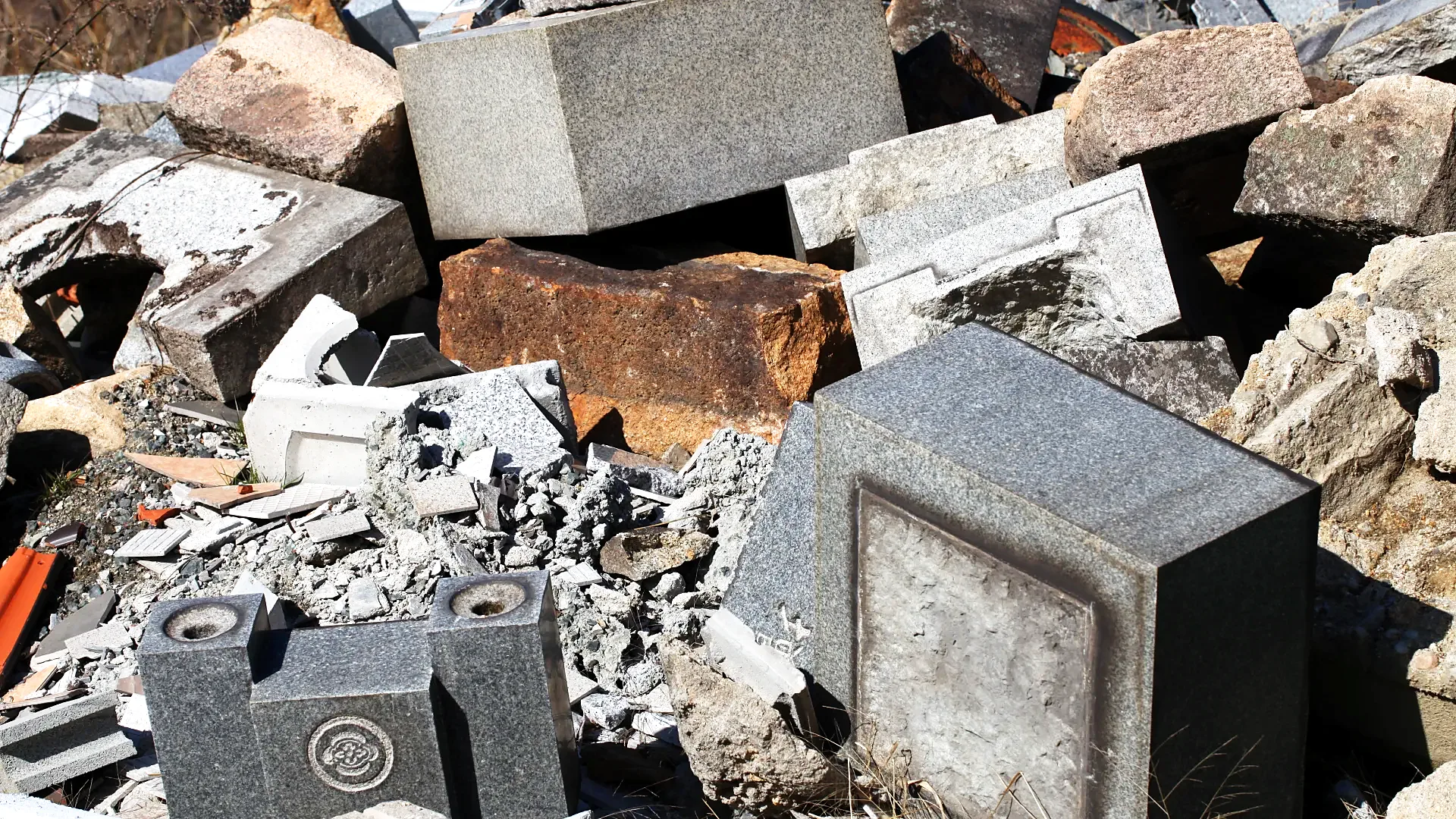
Visitors to Sakuraen often ask the same question: why would anyone stack gravestones into a pyramid? The answer starts with a change that is happening to family graves all over Japan.
What is hakajimai?
A traditional Japanese grave belongs to a family, not to one person. Hakajimai means closing such a grave. In recent years the number of families doing this has risen sharply.
The hotoke-ishi: the stone at the top
The top stone of a Japanese grave, engraved with the family name or the Buddhist names of the dead, is called the hotoke-ishi. It is also known as the sao-ishi.
This stone is believed to hold a spirit. Before a grave is closed, a ritual is held to release it. Some people say that after the ritual the stone is only a stone. We believe that the feelings of the family who built it do not disappear.
What usually happens to the stones

In the past, stones from graves with no one left to care for them were treated with respect. Temples and cemeteries set aside a place to keep them.
As more graves were closed, those places ran out of room. Because it is cheaper, more and more contractors now crush the stones. Some are buried as material under roads.
Why a stonemason built its own memorial site
Shioiribashi-sekizai is a stonemason in Nachikatsuura, founded in 1946. Since its founding, it has never crushed a hotoke-ishi.
The company looked for a place that would keep the stones and go on praying for them, and could not find one it trusted. So it built a memorial site of its own, Sakuraen.
At Sakuraen the stones are stacked in a pyramid with their inscriptions facing outward. The company holds memorial services about twice a month, and monks from a nearby temple hold services at the spring and autumn equinoxes. Stones of any Buddhist school are accepted. No ashes or remains are kept here, only the stones.
Gravestones are not industrial waste. That is the idea behind Sakuraen.
A tower that keeps growing
The tower at Sakuraen is 1,034 cm high. On May 2, 2024 it was certified as the tallest grave memorial tower in Japan. Work on a second memorial site began on January 16, 2025, and new tiers are added as it fills with stones.
Visiting Sakuraen
Sakuraen is in Nachikatsuura, Wakayama, just off the Ohechi route of the Kumano Kodo. It is free and open at all times, and anyone is welcome to come and pay their respects.
