The Kumano Kodo is a network of old pilgrimage routes across the Kii Peninsula, south of Osaka and Kyoto. For more than a thousand years, people have walked these trails to reach the three grand shrines of Kumano.
We run Sakuraen, a memorial site along the Ohechi route in Nachikatsuura, at the southern end of the network. This guide explains the routes in plain terms so you can choose where to start.
What the Kumano Kodo is
The trails lead to the Kumano Sanzan, the collective name for three grand shrines: Kumano Hongu Taisha, Kumano Hayatama Taisha and Kumano Nachi Taisha. Two Buddhist temples, Seiganto-ji and Fudarakusan-ji, are closely tied to them.
In July 2004 the shrines and the routes were registered as a UNESCO World Heritage site, under the name “Sacred Sites and Pilgrimage Routes in the Kii Mountain Range”. The listing joins three sacred areas, Kumano Sanzan, Koyasan and Yoshino and Omine, with the pilgrimage routes that connect them.
A short history
- Mountain worship in Kumano is said to go back to prehistoric times
- From around the 9th and 10th centuries, the number of pilgrims grew and the routes took shape
- In the 11th century, retired emperors and aristocrats made the journey from Kyoto
- By the late 15th century, most pilgrims were ordinary people
- In the Edo period, people walked the routes for sightseeing as well as for prayer
The main routes compared
| Route | From and to | Distance | Character |
|---|---|---|---|
| Nakahechi | Tanabe, on the west coast, to the Kumano shrines | About 38 km from Takijiri-oji to Hongu | The most popular route. Mountain villages with traditional inns, English signs and luggage transfer |
| Kohechi | Koyasan to Kumano Hongu Taisha | About 70 km | Steep and remote, with passes over 1,000 meters. For experienced walkers. About 4 days |
| Ohechi | Tokei-jinja Shrine in Tanabe to Fudarakusan-ji Temple in Nachi | Along the coast | Views of the Pacific Ocean. Developed in the 15th century and loved by writers and poets |
| Iseji | Ise Jingu to the Kumano shrines | About 170 km | Stone paving, rice terraces and long beaches. One to two weeks for the whole route |
Nakahechi: the classic choice
The Nakahechi is the route the imperial pilgrims used from the 10th century, and it is still where most visitors start. It is not technically difficult, but it is physically demanding. It is open all year.
Kohechi: the mountain crossing
The Kohechi links two sacred places, Koyasan and Kumano Hongu Taisha. It is one of the steepest pilgrimage routes, and the high passes are closed by snow from about mid-December to mid-March. Book your lodging in each village in advance.
Ohechi: the coastal route
The Ohechi follows the coast from Tanabe to Nachi. It is the route for walkers who want the sea beside them. It ends at Fudarakusan-ji Temple in Nachikatsuura, from where the trail climbs to Kumano Nachi Taisha and Nachi Falls.
One section of the Ohechi, between Wabuka Station and Tako Station, is closed for road work from June 8, 2026 until about April 30, 2027. Walkers are asked to use the train or bus for that section. Please check the latest notice before you go.
The last section of the Ohechi, in Nachikatsuura, is open. See our guide to walking from Kii-Uragami to Nachi.
Iseji: the eastern route
The Iseji runs down the east side of the peninsula from Ise Jingu. Short sections make good day walks.
When to walk
Spring and autumn are the most popular seasons. Summer is hot and humid. In winter it can be cold, with snow and ice possible from late December to late February. The Kii Peninsula has a lot of rain, and typhoons can affect the trails.
What to bring
- Layers, and clothes that are not cotton
- Shoes you have already broken in
- Rain gear
- A headlamp. The sun sets early in the mountains
- Sun protection and insect repellent
There are few shops and little phone signal in the mountains. Take your trash with you. Camping is generally not allowed.
Booking and the Dual Pilgrim
Book your lodging in advance. Turning up without a reservation is not the custom here.
The Kumano Kodo and the Way of St. James to Santiago de Compostela in Spain are both World Heritage pilgrimage routes. Walkers who complete both can register as a Dual Pilgrim, a program that began in 2015. One of the ways to qualify on the Kumano side is to visit sites on the Ohechi route and the three grand shrines.
Where the trail meets Sakuraen
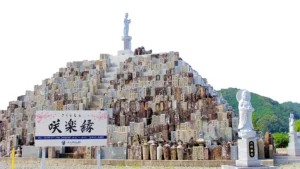
Just off the Ohechi route in Nachikatsuura, between Kii-Uragami Station and Nachi Station, stands Sakuraen: a pyramid of old family gravestones, certified as the tallest grave memorial tower in Japan. It is free and always open, and walkers are welcome to stop.