Kumano is famous for its shrines and its pilgrimage trails. Once you have seen the famous sights, here are five places in the town of Nachikatsuura that you are unlikely to find anywhere else.
1. A stone pyramid made of gravestones

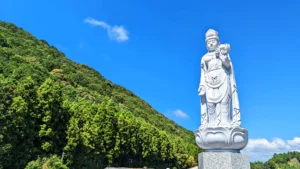
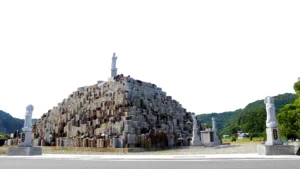
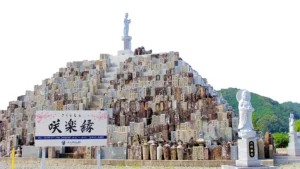
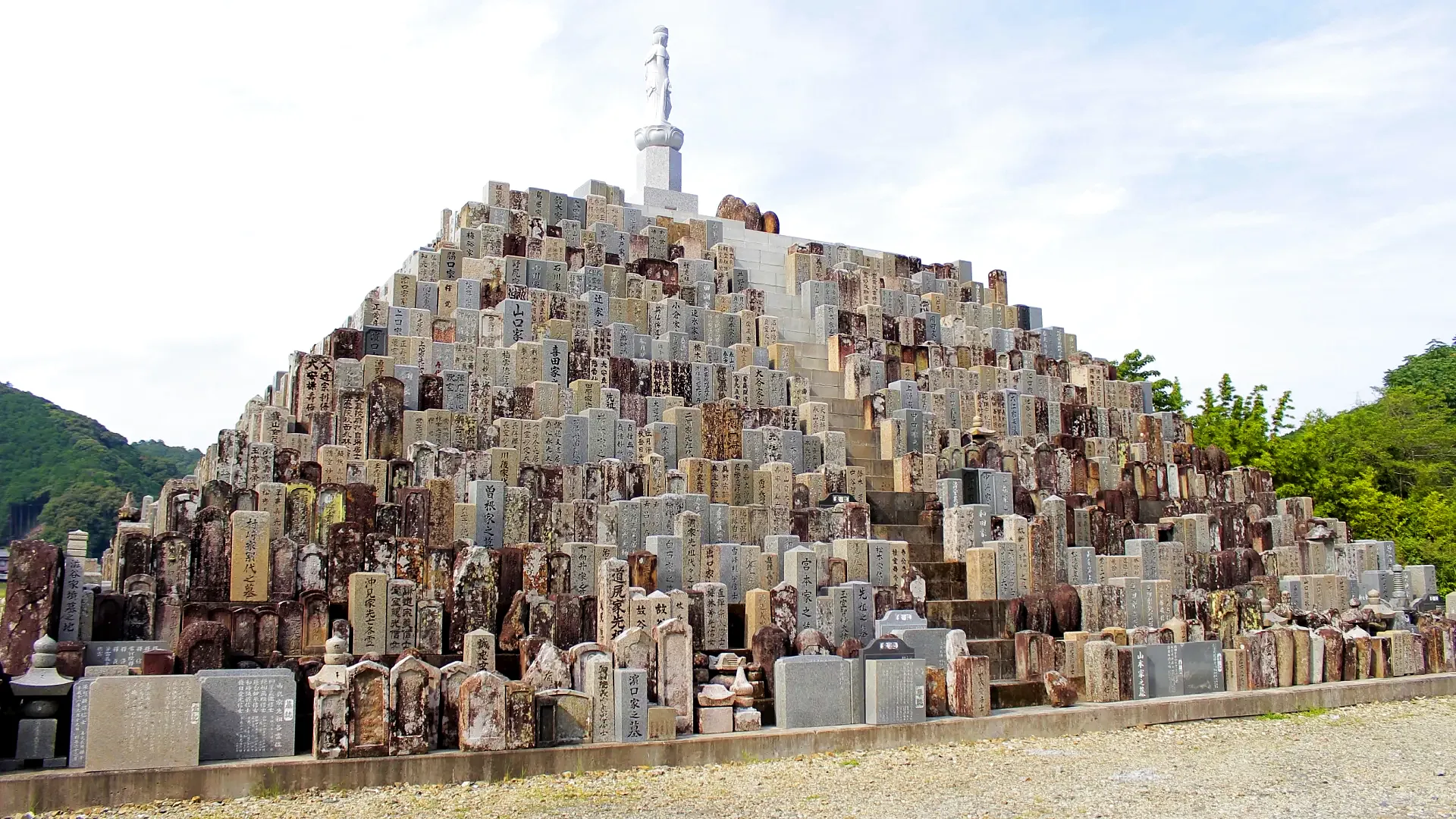
At Sakuraen, old gravestones are stacked into a stepped pyramid. Each one is the top stone of a Japanese family grave, engraved with a family name or the Buddhist names of the dead, and every inscription faces outward.
The tower is 1,034 cm high, about 34 feet. On May 2, 2024 it was certified as the tallest grave memorial tower in Japan.
Why build it? More and more families in Japan are closing their ancestral graves, and the stones are often crushed. The stonemason who runs Sakuraen has never crushed one. The stones are kept here and memorial services are held for them.
Sakuraen is free and open at all times, and photos are welcome. It stands just off the Kumano Kodo Ohechi route, between Kii-Uragami Station and Nachi Station. See how to get there.
2. A shrine with no building
Nachi Falls drops 133 meters, the tallest single-drop waterfall in Japan. What is unusual is that the waterfall is the deity. Hiro Shrine, at its foot, has no worship hall. You simply stand and pray toward the water. To walk there the old way, see our Nachi Falls and Daimonzaka walking guide.
3. A boat built for a one-way voyage
At Fudarakusan-ji Temple, near Nachi Station, monks once boarded small boats and set out to sea from the beach at Nachi, hoping to reach the paradise of the bodhisattva Kannon. A replica of one of these boats stands in the temple grounds.
4. A pond made three centuries ago
Yonego-ike is an irrigation pond on the Kumano Kodo Ohechi route, beyond Ichiya-toge Pass. Work on it began in 1708 and ended in 1711, and it is still there. A stone monument on the bank tells how it was made.
5. Charcoal kilns beside the pilgrimage trail
On the first half of the Ohechi route between Kii-Uragami Station and Nachi Station, the trail passes kilns where Kishu Binchotan is made. This charcoal is a traditional product of the region.
Seeing them together
Places 4 and 5 are on the walk described in our guide to the Kumano Kodo Ohechi route from Kii-Uragami to Nachi. For the classic sights, see 9 things to do in Nachikatsuura.
Sakuraen is run by Shioiribashi-sekizai, a stonemason in Nachikatsuura. If you visit, we would be glad if you shared it in a review on Google Maps.